In May of 2011, I embarked on several projects to improve the functionality of my 1985 VW Vanagon Westfalia camper. After installing a Bostig turbo charger and designing & building an Arduino-based battery monitor, I designed and installed a solar panel system to keep my beer cold all summer long. But of course, just as I finished the project, I set out on a 10-day kayaking road trip that was part of my kayaking 100 days in 2011! I always intended to share my experiences with this solar system and after having it installed for almost 2 years, it seems like a great to do so!
I put together a video walk-through of the system, so if you have about 14 minutes and want to see and hear all the nitty-gritty details, have a look below! (If you’d like to watch a 2 minute synopsis, check out the video at the bottom of this post.)
The goal of the solar panels was to allow for continuous use of the 12V refrigerator in my van during the summer months, since that would simplify the need to add or remove items from the fridge. Considering that I am always on the go during the summer, I wanted my van to always be ready to support my next adventure and that meant that the fridge needed to already be cold and stocked with beer! And since the pop-top portion of the roof is always loaded with kayaks and other gear and I wanted the panels to be useable without having set them up and take them down each time, it meant that I needed to mount them on the area over the luggage rack. But wait, I have more requirements! The solar panel also needed to be removable so I could set it in the sun when the van was parked in the shade. And finally, just one more requirement—I wanted to retain partial usage of the luggage rack!
Yes, I was able to meet all of those requirements and am extremely happy with the entire system almost 2 years later. The best way to understand how the system works is to watch the video above, but I thought I’d provide a little bit of detail about the components that went into the system in case you are interested in building something similar.
It has been a year since my first foray into Gore Canyon which also marked my 100th day of kayaking last season, and on Saturday, 9/15/2012, I had my second opportunity to paddle the majestic canyon. An abysmal snowpack and extreme drought resulted in the worst kayaking season in a decade, so when we began paddling Gore on Saturday, it marked only my 42nd day of kayaking in 2012. I felt a bit rusty but was with a great crew that consisted of Peter, Cindy & Stacey, Josh, Berkeley, and Kim the Man. The flow was only 760cfs and no one in the group was quite sure what to expect at that low level. It turned out that there was still plenty of water to run the usual lines, although in the cases of the Pencil Drop Sneak on Gore Rapid and the left sneak line on Toilet Bowl, this meant some serious knuckle dragging over rocks. It was a gorgeous, 70 degree day and everyone made it through the run in one piece even with Berkeley’s swim right above Tunnel Falls and my unintentional run of Tunnel.
I got to use my new WiFi Backpack with my GoPro for the first time and was able to capture footage of almost the entire run except for Tunnel and Kirshbaum’s Rapid. Here is the 4 minute version of Gore Canyon from my perspective—enjoy!
While there are many unique aspects of the Antarctic environment, one of the most interesting that it shares with the northern pole is its preponderance of sunshine during the summer months. For the majority of people who have spent their entire lives in the mid-latitudes with its daily cycle of light and dark, it is difficult to imagine a world without darkness. In an effort to share this unique place with those at home, I decided to see if I could somehow capture the endless light that we are bathed in each day in McMurdo.
Since the sun moves through the sky each day, a statically pointed camera couldn’t fully convince you that the sun remains above the horizon on its daily course. Fortunately, I happen to have a background in building solar tracking mechanisms (Glory TPS), but lack the congressionally approved NASA budget that is usually required for such a task. After a bit of brainstorming, I came up with an interesting possibility that I thought just might do the trick. A 10 minute trip to Home Depot and $6 poorer, I had my very own solar tracking system (aka, an el-cheepo mechanical lamp timer!) to which I mounted my newly acquired GoPro Hero2 camera. A quick test one afternoon at home convinced me that I was on the right track, and then I was off on my expedition to Antarctica.
Shortly after my arrival in Antarctica, I explored the rooftop of the Crary science building and temporarily erected a mast and boom structure from which I hung my solar tracking camera with power provided by a 120VAC extension cord. Among the oddities of the southern hemisphere is the relative motion of the sun in the sky. The next time you watch the sun arc its way toward sunset, note which direction it is moving and try to imagine how odd the day would feel if it made its traverse in the opposite direction as it does in the austral hemisphere. This direction reversal caused quite a bit of head scratching and ultimately forced me to hang the rig upside down with the undesirable, yet inevitable introduction of the structure into the camera’s field of view each day.
The finicky weather never cooperated for a full day’s worth of sunshine, but on my third attempt, I managed to capture over two straight days of solar tracking with relatively nice cloud conditions which I spliced into the time lapse movie seen below. Sit back and enjoy the show!
With a sun that never sleeps, the natural question I get asked all the time is if I am able to sleep? Well, it’s amazing what hard work and some room darkening shades can do, because I have had absolutely no difficulty achieving restful sleep each night during my few short weeks in this upside down land!
This holiday season, I feel great sympathy for Santa Claus and the extreme journey he takes around the globe each year as he delivers presents to all the children of the world. My own journey may not have been quite as arduous as Saint Nick’s, but traveling half way around the world for over 24 hours straight at Christmas time was still quite ambitious and worth every minute. Instead of finding neatly wrapped presents under a tree in my living room, my gift was a few days on the warm sand of New Zealand under the indigenous Kiwi Christmas trees!
This brief pit stop on the North Island was a great way for Lars, Sam, and I to take some personal time and break up the long monotony of air travel on our way to Antarctica. We arrived in Auckland midday on December 24th after losing a day at the International Date Line and proceeded directly to Waihi Beach at the north end of the Bay of Plenty. This sleepy beach town was in the midst of experiencing exceptionally nice weather which made the stunning coastline appear all the more breathtaking. The laid back attitude of the beach town was easy to adapt to during our first day, and we continued to enjoy this easygoing life on Christmas Day during a gorgeous hike up the coast to another cove and a tropical waterfall. Kiwi families were out and about on the trails and beaches after celebrating Christmas at home in the morning which was an interesting contrast to our usual expectations of a Christmas afternoon spent in the snowy North. Be sure to check out the photos below, or click here to open the photo album in a new window.
Colonial British countries, including New Zealand, have instituted a holiday immediately following Christmas called Boxing Day. Apparently this day’s name is derived from boxing up donations to send to charity after experience great wealth the day prior, but I think it is more likely just a great reason to keep the holiday season momentum going. Our last full day of vacation was spent celebrating Boxing Day with throngs of tourists and locals alike at a curious natural feature up the coast on the Coromandel Peninsula called Hot Water Beach. The ocean’s edge in this location just happens to coincide with a geothermal site that heats subsurface water and drives it up to the surface much like the thermal pools in Yellowstone National Park. However, the exact locations of the hot springs are limited to a few hundred square meters and are only accessible within 2 hours of low tide, so when tourists descend on Hot Water Beach, they do so in throngs. And when you add the fact that it was Boxing Day when we visited this attraction, you can only imagine the mad scene that ensued. In fact, the experience was both simultaneously hectic and ordered in the way of a beehive. After I caught a few waves on a rented surfboard, I perched my GoPro on a precipitous cliff high above the scene and captured this panoramic time lapse that does a nice job of conveying the natural and cultural oddity of Hot Water Beach.
We knew that our days on the beach were limited, and this morning we parted with the Bay of Plenty for a quick, 1-hour flight to Christchurch on the South Island which is our launching point to Antarctica. Upon arrival at the Christchurch airport, we were greeted by a representative from the United States Antarctic Program (USAP) who briefed us on our schedule for the next two days and warned us that aftershocks are persisting from last week’s earthquake. The news was not meant to be frightening, but it was a somber reminder of the natural disasters that have struck this city twice in the past year. Although we had heard of the damages the city had sustained, we boarded a bus to view them first-hand. Initially, we concluded that perhaps the damage was not as bad as reported, but upon further exploration, we came across a city that looked war-ravaged with closed streets and fatally compromised structures. The downtown was barely passable as a place worth visiting at all, but farther away, the smaller buildings showed less damage. Unfortunately, the city’s namesake church was irreparably destroyed in last year’s earthquake when its high steeple toppled to the ground, and now construction towers scrape the sky in its absence. On a more positive note, the Canterbury Museum survived these recent natural onslaughts, so we are planning on a quick visit to it and the adjacent, lush botanical gardens tomorrow morning prior to our departure to the cold, white South.
In 24 hours, I will be stepping foot on the most remote, the highest, driest, windiest, oddest, and of course, the coldest continent on the planet- Antarctica! Stay tuned!
For the second Saturday in a row, I had some fun mounting my new GoPro Hero2 onto something unique in order to capture a cool vantage point. This time, I attached the camera to my stock Bixler remote control (RC) airplane and launched it into the wild blue yonder! If it seems like I’ve done this before, it’s because I flew Gumby on my old EasyStar plane just before Christmas 3 years ago. And if you remember that video, you also remember that the quality was far from perfect due to the live streaming downlink I used at the time. Well now that I have a high-definition GoPro, there’s no excuse for grainy video anymore, but as I found out, the quality still wasn’t quite perfect. I shot all of these clips in the 1080 30fps mode with full-width 170 degree field of view and you can certainly see the significant fisheye distortion along the horizon lines, so the next time I fly, I’ll try the slightly narrower 127 degree field of view which should significantly decrease the distortion. Another minor gripe is that the vibration of the electric motor resulted in a slight “jello-effect” if you look closely, but I’m hoping that the anti-vibration plug accessory will cut down on that on future flights. On the plus side, the plane flew extremely smoothly and there was no need to stabilize the video digitally in my video editing software. Overall, I’m thrilled with the footage from my first 4 flights and can’t wait to fly again!
And if you’re interested in how I mounted the camera, it really couldn’t have been easier. I reused the display mount from the packaging and simply trimmed it to fit within the cockpit area. In order to attach it, I wrapped two of the 2-sided velcro straps around the camera plate and the fuselage and voila, instant GoPro mount for my RC plane!
I finally bought a GoPro helmet camera and have been dying to try it out. Unfortunately, it’s been a little too chilly to kayak and I’m not quite ready to mount it on my RC plane or quadcopter, but I’ve always wondered how River Dog sees the world. So this morning I had a little fun playing with the new camera and then figured out how to use my new PowerDirector video editing software. Check out the morning from River’s perspective:
Although this is my first GoPro helmet-cam, it isn’t my first helmet-cam, nor is it my first GoPro. Over a decade ago, I rigged up a helmet-cam by mounting a spy camera in a headlamp with wires and batteries that hung off my head and led down to a full size camcorder that was stashed in my backpack. At the time, it seemed pretty innovative compared to the previous standard of mounting an entire camcorder to your helmet! It also isn’t my first GoPro. Before they became the unanimous leader in point-of-view (POV) digital cameras, they sold inexpensive waterproof film cameras at whitewater rafting gift shops. It’s impressive to see that waterproof enclosure design has barely changed in all these years while the digital technology of today was unthinkable a decade ago. So far I’m really impressed with the Hero2 from GoPro, and I’m thrilled to add it to my camera quiver! You will be seeing lots more footage from in the coming months and years!
To continue with my recent theme of technology articles, it seems appropriate to touch on another interesting photographic method-- time lapses. You’ve seen them on TV more times than you can count, but I doubt you have ever created one. Depending on the hardware you have, it may be a simple or complex endeavor, but it can be quite fun and can potentially reveal something that would be difficult to observe otherwise.
One of my favorite time lapses is shown in the video below and reveals significant motion of an iceberg in Alsek Lake in Alaska over a the course of about 2 hours. This scene is particularly interesting to me, because as I sat on the shore of this incredible lake with my friends for several hours, we would occasionally note that the massive icebergs had moved significantly right before our eyes without any perceptible motion. So in the remaining day light hours, I captured this berg’s motion and confirmed that it was indeed moving quite a bit right in front of us.
As part of my effort to explore the many ways that digital media can be used to share stories, I have invested considerable time and energy creating small videos that I have posted to my YouTube channel. These videos have ranged from my favorite clip of a humpback whale to Gumby flying my RC plane to time-lapses of space-borne scientific instruments to photo/video montages of my kayaking exploits. But no matter the subject, the fact remains that being able to quickly and repeatedly generate content is the best way to share the story behind the video. In order to accomplish this throughput, I have used Windows Live Movie Maker as my video editor for the past several years. It is an extremely simple, yet robust, free video editor for Microsoft Windows that is analogous and quite comparable to iMovie for Mac computers. But after a while, simply being able to generate content consistently was no longer enough. After spending all of that time creating videos, I realized that there were capabilities that simply did not exist in Movie Maker and so I set about to find a better solution.
We all knew that 2011 would be a year for the record books in the Colorado kayaking world, but none of use knew exactly how it would turn out. After an absolute whirlwind the past several months, I finally have a few moments to recap some of the most memorable trips from this exciting kayaking season! During the month of May, I spent almost every waking minute that I wasn’t working on my van installing the turbo charger and the solar panels, so I didn’t have much to show for kayaking, but on Sunday the 22nd, I had the opportunity to join some friends on the Upper North Fork of the Poudre River which is a beautiful wilderness run that cuts through the rolling grasslands north of Fort Collins and just south of Wyoming. We had plenty of adventure including extraction of a kayak that was pinned on a log above a class V waterfall. The day was beautiful and the photos actually do the scenery justice quite well, so be sure to check them out in this photo album.
The month of April has passed 2011 by, and I’m glad to say that I made it out kayaking quite often despite the low flows. But don’t be fooled, according to the experts (see map at right) we are in for a banner year of river flows. I’ve even heard that the snowpack for the Poudre River hasn’t been this high since 1983! So with all that water soon to be on its way rushing down the mountains, it’s even more important to be comfortable in my boat and ready to go!
If you’ve been reading this blog, then of course you know that I started out the month with a great weekend down to the Arkansas River. That was followed by a very low water (60cfs) session in the Golden play park prior to the CW Spring Dinner that featured Ben Stookesbury. After that, another warm evening at Confluence in Denver let me continue to get used to my new Villain ‘S’.
Two days later, I was working my way down Waterton Canyon for the second time this year, but in my new Villain instead of my typical SuperStar playboat. We all had a really great day, and I managed to capture some nice photos with my new Panasonic TS3 waterproof camera, so I created a quick slideshow video and posted it on Youtube.
The following weekend, a crew of 25 people was destined for an overnight trip down Westwater Canyon, but as the weather turned sour and the flow increased to a little over 10,000cfs, the team dwindled all the way down to 9 hearty souls. As it turned out, the weather was never too bad for our day trip and the higher flow was still just good ole’ fun on the water. But for me, the thing that made the trip really memorable was that Robert and I took a two-person kayak, the Jackson Dynamic Duo, down the river despite the fact that we had never paddled one before. Both of us were confident before we set out, and after a few practice rolls, we crossed our fingers and headed into the rapids that turned out to be much more punishing for the person who got stuck sitting in the front- not me! After our quick jaunt through the canyon, we met up with the rest of our crew and a hotel (well, Super 8 actually) party ensued that was a throw back to all of our younger years. On Sunday, Scott, Bart, Robert, and I paddled from the No Name exit down to the South Canyon exit and even managed to get in some Duo surfing at the Glenwood Wave! Check out all the photos in this slideshow video .
Finally, the month concluded with Flatwater/Movingwater Weekend (FWMWW) which is the practical, outside portion of Colorado Whitewater’s Beginner Kayaking Class that Robert and I taught this year. We had a fantastic group of new boaters and not so fantastic weather for being on the water the first time, but they all did incredibly well and the weather even managed to do better than the forecast had predicted. By now, I think you know what to expect- that’s right, another slideshow video, so have fun watching!
It began with a sketch on a whiteboard just under a year ago, and today the device is functioning beautifully in my van. Granted, I only worked on this project for about 2 weeks last year before kayaking dragged me away from it and during the past 2 weeks, but it is still gratifying to finally have this project up and running after a year of contemplating it and finally resolving to get it done!
The Westfalia camper package in Volkswagen Vanagons is one of the coolest little toys you can imagine. It’s like having a house on wheels with a footprint no larger than an ordinary car. Or as I like to think of it, it’s like having all the subsystems from a satellite in the back of my vehicle, except for the fact that I can modify them electrically and mechanically without going through a multi-year design and approval process. When it comes right down to, I love to camp in the van, but the ability to modify it to suit my needs is the kind of play that really makes the van a hobby unto itself.
After I completed the engine conversion 2 years ago, I decided it was time for some proper refrigeration of beverages. You see, the original Dometic 3-way fridge was a neat little piece of equipment, but I spent substantial time tweaking and monitoring its performance only to realize that it just couldn’t cope with the heat of the summer. The mountains on my frosty Coors Lights just weren’t staying blue, and if there is one thing I can’t have, it’s a warm Coors light. After much research, I invested in an ARB Fridge/Freezer that is rated to maintain subfreezing temperatures in 90deg heat while consuming very little power. First off, let me say that the fridge is incredible, and it really does do everything they claim. But the fact of the matter is that power has to come from somewhere, and in my case, it came from an increasingly large and complex auxiliary battery system in the van. Then you combine this complex system with the notoriously unreliable Vanagon starter that masquerades its degrading performance as a battery problem, and you wind up with good ole’ Pat scratching out his remaining hair over the course of the past year trying to figure out what was happening in the van’s electrical system.
I believe that there are two ways to solve problems. The first and most conventional way is to simply attack the problem and try to get things done. It might be not be fun, but you end up arriving at the answer. I think of this as “work”. And work just isn’t that fun. The second, less traveled path, is to put a smile on your face and explore the problem for what it is. This approach not only gets you to the answer, but it takes you to many other cool, rewarding places along the way. I think of this as “play”, and this is the way I prefer to solve problems. So when I was faced with a difficult problem to solve in my van’s electrical system last year, I didn’t just take out a voltmeter and track down the offender. Nope, I decided that I would use it as an opportunity to explore the cool, new world of Arduino microcontrollers with the hope that I could design a system that would provide far more insight to my van’s power system than any normal person would ever think is possible.
It was April 23rd last year when I sketched out a block diagram of the van’s power system and started trying to implement the system in the Arduino with the help of my good friend’s Lars and Sam (who also helped me make my tethered balloon system a reality). In essence, the Arduino is a small microcontroller (super simple computer) that I am using to read the analog voltages from the 3 batteries. Since I wanted to be able to monitor the voltages in real-time, I added a Parallax 4x20 character LCD and a momentary contact switch to change the display views. Finally, in order to debug any problems with the electrical system, I wanted to understand what was happening to these various batteries over longer time periods. The simple option would have been to write down the 3 voltages on a regular basis and try to figure out what was happening, but in today’s age of technology, manual data logging just seems so outdated. So to accomplish the data logging, I added a microSD memory card to the Arduino with Sparkfun’s microSD shield. The coding of the Arduino was extremely simple apart from a bug in the LCD code I downloaded and an initially poor choice in the SD code that I used which was remedied with the newer code on the Sparkfun site.
Yup, it’s almost a year later but I have the battery monitor installed in my van now and it’s working! Rather than try to describe the system in detail here, I put together an in-depth video that walks through the whole system and shows off all the cool features. It’s not a short video, but if this is your kind of thing, you might actually enjoy it :-)
Finally, if you’re a geek who wants to take a look at what the battery voltages look like when the van is started and stopped, then this plot is for you.
Sure, I could have solved the problem the straightforward way, but then I never would have explored all these cool new worlds. By the way, I still have a smile on my face :-)
There is something special about the first boating trip of the year. For me, it seems to come earlier and earlier each year, and prior to this weekend, I had already been on the water 6 days including Confluenza on the South Platte, my adventures in California, and Waterton Canyon. Last year, I kicked off the season with Scott and Robert with a fantastic trip down to the Arkansas River Valley for the closing day at Monarch ski mountain followed by a day boating down the Royal Gorge. This year, Scott and I decided it was time to do it again, but Jennifer joined us in place of Robert and we decided to mix up the boating a little bit! It was also a great opportunity to test out my Panasonic TS3 waterproof camera that has Full HD video, although I decided to tone it down a bit with ‘just’ 720p video :-)
We skied at Monarch on Saturday in spring conditions and hopped in our kayaks mid-day to race down the mountain in the Boatercross event! Scott and I competed in a field of 40 boaters with heats of 4 people racing down a course that ended at a pool of water just before the finish line. The course wasn’t steep, but there was mayhem on the slope as we spun each other out in hopes of reaching the bottom first. After 2 rounds, Scott and I were eliminated and it was time for a beer and more skiing. Still, I’m happy to now say that I have kayaked down a ski slope! Check out a quick video clip of the second heat when Scott and I competed against each other.
After we wrapped up skiing, we headed off to the Salida play park for almost 2 more hours of kayaking. It was great to get out in my new Jackson Villain S for the first time, even though there was only 220 cfs. Apart from last year’s Pole Pedal Paddle event, I had never skied and kayaked in the same day, but Springtime in Colorado is really wonderful that way! We wrapped up the day with dinner at Benson’s and the always classy Salida East for car camping.
Sunday, we took our time in the morning to let the weather warm and enjoyed a lazy breakfast at the Boathouse. Around noon, we finally put on Parkdale at 340 cfs and played our way down the boney rapids for several hours. At the conclusion, a mild take-out party ensued in the warm afternoon where we discovered that the weather in the Front Range was not so favorable with snow and freezing temperatures! Eventually, we had to face reality, snowy roads, and the upcoming work week. But for the time being, we chilled out, sipped our beers, and enjoyed the first boating trip of the year…
It is a truly sad day for hundreds of dedicated people who staked their bets in this high risk enterprise. We have collectively created something amazing over the course of a decade and lost it in an instant. However, we all knew the game when we got into this. It’s not for the faint hearted. As in life, you don’t get a second chance.
But right now, I remember that things aren’t so terrible. There was a machine- a robot of sorts on this rocket, albeit a very beautiful robot. However, there was no loss of human life, just a sizeable dose of disappointment. It’s important to distinguish what matters, and what really matters.
So now we sit tight. That’s all we can do in the very near term. There will be press conferences, there will be investigations, and for our LASP team leading the charge on solar irradiance measurements , there will be an adamant campaign to accelerate the bureaucratic wheels to get the TIM instrument into orbit as soon as possible!
One-two. Down, but not out.
Here is an interview I did today with the Denver NBC affiliate, 9NEWS, and the associated website link.
What better way to kick off meteorological summer than a long weekend of kayaking? A bunch of us headed out to Glenwood Springs over Memorial weekend 2010 to catch the run off on the Roaring Fork and Colorado Rivers and we had an incredible time!
The excitement started early in the trip when the van decided to stop working 1/4 mile into Eisenhower Tunnel during one of the busiest travel days of the year! Like the Secret Service protecting the President, the tunnel crew swept into action within 30 seconds by closing the tunnel and dragging the van out with a tow strap! We were shocked by the immediate response and even happier when the van started up again after 5 minutes of rest. Whether it was vapor lock or overheating, we were happy to be on our way again.
On Saturday, we had a great high water (5000cfs) run on the Cemetary stretch of the Roaring Fork River that included some fun wave trains, and then we headed up stream towards Aspen to run the Slaughterhouse section (1000cfs) of the Roaring Fork. It was Scott's, Robert's, and my first time down the run, but it felt pretty comfortable with Mark leading the way. After that, we picked up Dede and Karen and continued down the Upper Woody stretch which was really exciting at that level.
On Sunday, we turned our attention to the Colorado River which was pumping through Glenwood Canyon at 8900cfs! Scott, Robert and I put in at Shoshone and were blown away by the big water feel of the run at that level. We then picked up Dede, Karen, and Jen and continued down through the Grizzly stretch all the way to the Glenwood wave where we got some surfing in. The girls were able to capture some video action of us going through Shoshone, but of course it doesn't really do justice to the feeling that we had in the chaotic water!
Monday started out a bit slow and we found ourselves back at the Glenwood wave for some more surf action. Once again, there was some video captured and I spliced together a fun little movie of our surf sessions.
Afterwards, we hopped back on I-70 towards Denver with a stop off to run the Upper Eagle. Robert and Mark got in a quick shot down Dowd Chutes where Scott and I joined them for an incredibly quick run down to Avon at 2500cfs.
I have a handful of photos from the weekend in this photo album.
All in all, it was a fantastic weekend of kayaking and hanging out with friends!
2010 will hopefully be the year that the NASA Glory mission launches into space. I have been working on the Glory-TIM instrument since 2004 and am extremely excited to have my own system fly in space for the first time! If I haven't told you about it before, I designed the pointing system for the TIM instrument that will allow it to look directly at the sun as the spacecraft orbits around the earth. As the November 22, 2010 launch date grows closer, Glory is beginning to receive attention in the press, so I thought I would report on some of the interesting stories out there.
Now on to my entries in the Glory news! Last week, I was interviewed about the connection between Glory and the hit t.v. show Lost, and a great article was posted online. Here is an excerpt:
You might think the South Platte River that runs through downtown Denver is dirty. And you’d be right, which is exactly why I had always avoided kayaking the whitewater drops in Confluence Park. But yesterday, the spring rains had flushed most of the junk way down river (or so I told myself), and the waves were at a perfect level for a few hours of kayak surfing in the Spring sunshine. Have a look at the video and you’ll see why I have a newfound respect Denver’s kayaking scene.
What do you get when you strap a camera to a ski pole, then to mountain bike handle bars, and then kayak one handed so you can film the river? You get my decidedly “recreational” entry in the 2010 Salida Pole Pedal Paddle race and you get a fun, first person view of the race course shown in the video below.
So what if I came in last or second to last place? When and where else can you get the opportunity to ski, mountain bike, and whitewater kayak all in the same day? And when and where can you actually link these three activities together sequentially in a really fun course? April in Salida Colorado, that’s when and where. And that’s exactly what the 3P organizers and around a hundred athletes do each year in this unique event. In case you couldn’t tell from the video, it is a fantastic time and I highly recommend it if you enjoy these sports.
In addition to filming throughout the course, I also carried a GPS in order to mark the route and get an idea of how fast/slow I went. You can get a sense of race course location and my speed in the interactive map below, or you can download the GPX or KML file to view in Google Earth.
The expanded analysis of the January 5 balloon flight to the edge of space is finally available! If you aren't a geek, you will be probably be satisfied with the YouTube documentary and photo albums that are presented below. But if you have been asking questions like, "How high did it go?", or "How come the camera didn't get too cold and stop working?", then you should keep reading after the fun multimedia shows.
If you enjoyed the movie and want to browse through the photos at your own pace, be sure to check out this annotated photo album.
Now it's time to get down to geek business...
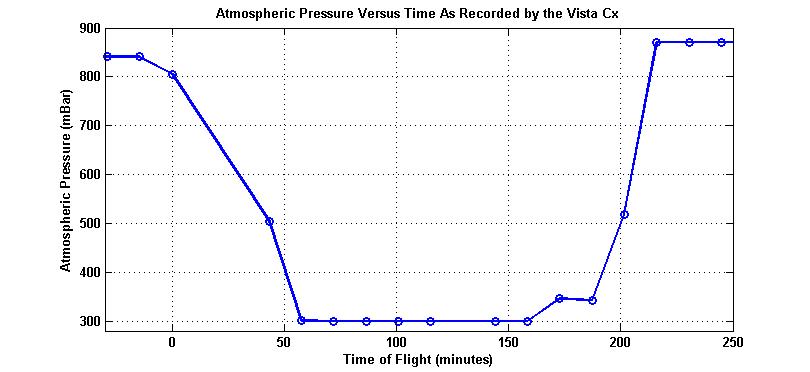
The number one question I have been asked has been, "How high did the balloon go?" In order to answer this question, we flew my Garmin Vista Cx that logged GPS location every 5 seconds and also logged barometric pressure/altitude. I configured the GPS to use the pressure in the altitude calculation, since I had heard rumors of consumer GPS not working at high altitudes. However, upon recovery we were disappointed to discover that the barometric pressure saturated at 300 mBar (30k feet) and the cadence was very slow (~15 mins/sample).
The saturated pressure resulted in a GPS profile that maxxed out at 30,000 feet. However, the rise rate up to that elevation and the descent rate had great fidelity, so there was hope at estimating the maximum altitude. Finally, the photos were taken at regular 1-minute intervals, and the images showed clearly when the balloon popped, since they began to tumble irregularly. So with a little engineering detective work, I was able to estimate the maximum altitude at 93,687 feet as seen in the plot below!
Another interesting lesson we learned regarding altitude was that the SPOT does not provide altitude in its location reports. Because of that, when we received updates near the predicting landing site at Limon, we assumed that it was on its way down. We spent several minutes looking up in the sky, only to learn much later that it was at its apex at that time!
Garmin MapSource software was used to determine the speed of the balloon throughout its trajectory based on the time-tagged GPS locations. The plot below shows that the speed was at its maximum when it was traveling in the jet stream. However, the maximum speed was not properly reflected, since the vertical component during free-fall was not part of the GPS data.
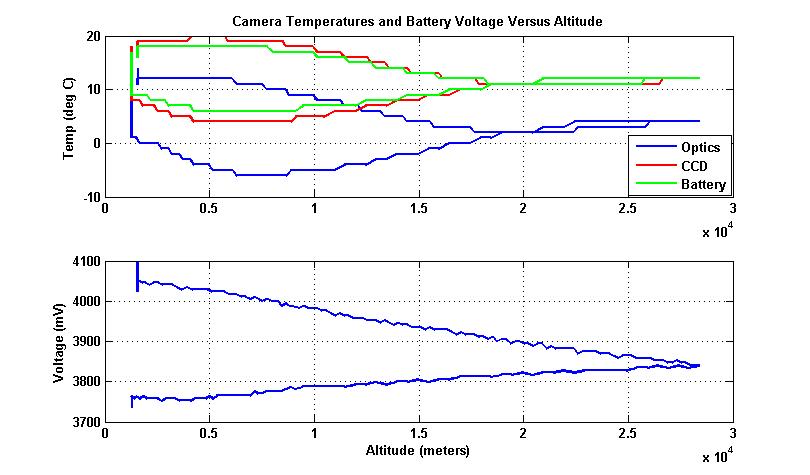
The other question that has been asked frequently has been, “How did the camera not freeze in the cold upper atmosphere?” First off, we packaged it in a styrofoam container that helped to maintain a warm environment, and secondly, Lars built a resistive heater using two 9volt batteries. But still, we didn’t know how things would turn out. However, Sam discovered that in CHDK, he could log temperatures in the camera, so that if it did stop working during the flight, we would know what conditions caused the problem. He was able to configure the SD800 to log the temperature of its optics, the CCD sensor, and the battery, as well as the battery voltage every minute when the photos were programmed to be taken. Additionally, he created a low-power mode (3.7volts) that would take photos less frequently. As previously said, the camera was still operating when we recovered it which was a testament to his programming and the camera itself! The plot below shows that the coldest portion of the camera was the optics housing, which wasn’t surprising, since it was exposed to the outside environment. We were pleasantly surprised to see that camera stayed relatively warm throughout the flight and that a heater may not even be needed if we need to save weight in the future. You can check out a plot of the temperature versus altitude here and try to explain to yourself the reason for the temperature at the apex of the flight.
All of this data is really fun, but questions kept coming up when looking at the photos. People would ask, “How high was it in this photo?”, or “How fast was it traveling in this photo?” Since I had the times of all the photos and time tagged data, I was able to correlate the two and ultimately insert the data into the description field of the IPTC header for each of the photos in this album.
Finally, with the newly predicted altitude, I was able to modify the GPX files and incorporate the predicted profile into Google Earth. That profile was then used with RoboGeo to geotag the annotated photos to create an interactive experience in Google Earth that provides a comparison between the predicted path, the measured path, the extrapolated path, and the SPOT update locations. And to top it off, satellite cloud imagery was overlaid in order to show correlations between the camera photos and the satellite photos! (SpaceBalloon140.jpg, 215, 225, 232 shows the blob cloud with the same perspective as the weather satellite photo overlay.) You can get the KMZ file here.
You would think I was done with this data-rich, multi-media interpretation of the balloon launch, but I also decided to publish a Blurb book with the best photos from the album. After all, this website is all about digital stories, right? Click on the link below to preview or order the book.
After a summer-long hiatus from the piano, I returned to lessons with the intent to play Coldplay’s Lovers In Japan, but based on my teacher’s recommendations, settled for Lost! instead. Having never been through music lessons as a child, I never knew the fear associated with a piano recital, and it didn’t take me long to freeze up in front of a bunch of parents and little kids while playing the Beatles’ Ob-La-Di at my first recital and vow to play much better at my next recital. Three weeks of learning and practicing Lost! paid off at the Christmas recital when I played smoothly through the song despite my paralyzing fear. As proof that I actually learned to play the piano, I recorded myself earlier today!
I suppose you are wondering if I will follow up with more resolutions after last year’s successes. I have thought about new things to accomplish, but the only unique idea I have had is to learn to wrestle alligators! So instead of doing silly things just for the sake of doing something new, I’m going to keep working on these existing goals. I have been having a great time learning piano, so I plan to continue lessons and learning new songs in the year to come. My van is working great and I expect that I will continue to restore it to better-than-new condition. Last September, I got certified as an American Canoe Association (governing board of kayaking) instructor, so next year I will be sharing my knowledge and passion for kayaking as I instruct others through the Colorado Whitewater association. And lastly, I will take a photo from my helium filled balloon!
The weather was cold and the nights were long back in late December when I decided to attend EJ’s kayaking class on the Ottawa River. My decision morphed with other goals and New Year’s resolutions to the end result of having kayaked 50 days (including the Numbers), having bombproofed my roll, and having radically modified my Westfalia by the time I completed the long drive to the Ottawa in late July. You could almost say that the very act of choosing and committing myself to this challenging class was the watershed moment that had the greatest impact on my kayaking. But as I like to say, it is one thing to talk about something and another to commit yourself and actually follow through.
Three other students (Olly, Neval, and Scott) and I were paired with the king of kayaking, EJ, and the prince, his son, Dane for five intensive days of instruction and playing on the river and an equal amount of goofing off and story telling off the river. When the week was over, we were all sad to part our separate ways, but our bodies were grateful for the respite.
The Ottawa is a very interesting river that is in great contrast to the rocky mountain rivers of Colorado that I am so used to. It is located in a very flat section of Canada a few hours north of Toronto and drains an extremely large area that corresponds to an equally large flow. For all intense purposes there should not be any rapids, but several geologic faults in the underlying granite bedrock cause large step changes in the river profile that results in the ultimate pool-drop rapid situation with big water! The whitewater sections of the river are dispersed over several miles with large lakes (pools) between each of the main rapids (drops). And within the stretch of water, the river splits into two primary channels- the Main Channel and the Middle Channel.
We spent every day except Wednesday on the Middle Channel, since it had a larger number of features in which to play and practice our skills. The gauge height of the river was 6’ on Monday and was certainly much bigger flow than anything I had was used to boating. It just so happened that our class occurred on the perfect week, since the previous month of rainy weather resulted in uncharacteristically high flows for that time of summer but with the added benefit of sunny weather. The flow was not only high on Monday at 6’, but it actually doubled in gauge height while we were there!
Both channels began with the first drop down McCoy’s rapid. Sattler’s Hole blocked the left portion of the river and just down stream, Phil’s Hole blocked the right portion. Fortunately, there is a multitude of ways to navigate these large obstructions, many of which involved finding a small seam right through the gut of the holes or just plain going into the holes and getting spit out eventually. Each day, EJ had us run a different line, so by the end of the week, we had learned to make it through the rapid no matter the situation. Personally, I had a few issues with the holes, since my skirt imploded on not one, but two occasions while getting window-shaded in them! The first time, I eventually exited my boat after about 5 rolls with a boat full of water, so when it happened again, I committed myself to paddling through the remainder of the rapid with just head, shoulders, and paddle above the water!
The next major feature that we encountered on the Middle Channel was the scenic Little Trickle, which was comfortingly reminiscent of Colorado boating. Once again, we ran many different lines down the rapid, each of which I thoroughly enjoyed, but with the boof move at high water being my favorite. Following that were two smooth, fun surf waves- Angel’s Kiss and Butterfly, which served up great playboating opportunities at every water level.
And then came Garvin’s Chute- a 15’ river wide waterfall with several navigable routes and many places that you don’t ever want to find yourself. Approaching it always got my heart racing as primal fear overtook my body. On Monday, the scout left me initially awestruck at the power and beauty of Dragon’s Tongue that coursed right down the center of the drop. But after watching Neval heroically run it without incident, I vowed that I would perform the feat the next day. And that I did! Despite the fear that cloaked my whole person, I followed Dane right down the smooth tongue while focusing on my target at the end of the tongue and not the side drop offs into living hell. I dropped off the bottom, experienced a surprisingly hard impact in the white, aerated water, and emerged a second later unscathed and easily able to make the move to avoid the huge hole that remained below. Phew! I definitely earned my lunch on Tuesday!
But then came Thursday with flows at the 12’ level and the option to run Elevator Shaft on the far right side of Garvin’s. Dammit! If I thought Dragon’s Tongue was intimidating, Elevator Shaft was at an entirely different level. The water plunged 10’ straight down onto the rocks below, which we were assured would not present a problem. That is, as long as we went over it right-side up. Because God only knows what would happen if you decided to have your face cushion your boat’s landing instead of the other way around. And one more thing. There was a reactionary wave just above the actual drop that wants to flip you, but that is not particularly challenging for a solid Class III boater. EJ summed it up appropriately, “Only run this if you are absolutely, 100% positive that you won’t get flipped by the wave.” So there I stood again on the precipice of Garvin’s Chute with that wave of fear descending on me. But I decided to keep a pact with myself that I would throw myself into every challenge that was presented to me during the class as long as it was within my ability. And when I looked at the moves that I needed to make, I had absolutely no doubt that I would be fine. And as fate had it, I went smoothly over the wave, down the drop, and earned my lunch once again. However, the next day one of the students in the Keener program did not stay upright but fortunately managed to make it out of there only banged up and limping. Yikes!
After Garvin’s came the two most poorly named rapids on the river, Upper NoName and Lower NoName. Upper NoName presented a fantastic, clean surf wave while Lower NoName featured big-water rapids with numerous waves and holes scattered throughout. The higher flows on Thursday and Friday changed Lower NoName’s character from a fun, semi-mellow descent to a rockin’, rowdy trip over big waves and around (or through) big holes. On the appropriately dubbed Big-Water-Thursday, attempting to surf a difficult to catch wave at the bottom of Lower NoName was on the menu. The trick to catching this wave was to “surf across Vampire hole” in order to ferry over to the wave. Well, it was technically within my means, so I had to do it, right? After not using Vampire Hole to my advantage the first time and missing the wave, I decided to throw my self smack-dab into the hole and then simply ferry across. Of course, we all know that good stories come from things never being as simple as they seem or as easy as EJ makes them look, which ultimately ends up with some quality carnage. I definitely caught Vampire Hole the next time and got a super rockin’, powerful surf for much longer than I had hoped for! It then spit me out and over into a deceptive little hole that was hiding completely out of sight in the center of the river upstream of the nice surf wave. Vampire has a deservingly mean name, but that nameless hole put more of a beat-down on me than its Transylvanian neighbor. I was window-shaded, or as EJ calls it, “power-flipped” for what seemed like an eternity and which included a shocking, kerthunk of my helmet on the rocks below in this supposedly rockless river. Thankfully, it released me and no swimming was involved. I then proceeded to rest my tired body on the shore for a few minutes before getting back on the horse by hiking back up and running Lower NoName again. When all was said and done, a new hole had been named on the Ottawa- Pat’s Hole.
You would think that was it for play features and beat-downs on the Middle Channel, but you would be wrong. There was minor feature named Warm Apple Pie just around the corner from the take out. So on Big-Water-Thursday, we decided to check it out. As we approached, EJ described it as a “super-retentive hole, but you can always make it out the sides.” Dane and EJ proceeded to throw ends, blast, mystery-move, and generally make it look like good fun. So at his invitation and in keeping with my pact, I decided to hop right in there. It turns out that when EJ describes something as “super-retentive”, it is no joke. I got flipped in the pour-over, rolled up completely disoriented, only to get sucked back in and flipped again in what seemed like an infinite loop. Well eventually, at the first opportunity when I had my wits about me, I heeded EJ’s advice, paddled like hell to the corner of the hole and made it out of there in one piece. Wow! What a day Big-Water-Thursday was for me- skirt implosion in Phil’s Hole and no swimming, then running Elevator Shaft, then getting trashed in Pat’s Hole, and finally getting spanked in Warm Apple Pie! Oh, and did I happen to mention that I did all that in a playboat that I had never paddled before? :-) When people ask me what I came away with from the class, I now say that I went to see the Wizard and I was given Courage!
But wait there’s more! I can’t neglect to mention the Main Channel that we ran on Wednesday at 11.25’. Compared to the number of features on the Middle Channel, the Main was sparser but also that much bigger. With names like Bus Eater, Waikiki, and Coliseum, you can instantly recognize that the Main is not for the faint of heart. Bus Eater is easily one of the most famous surf waves in the world, but it doesn’t “come in” until the flows are great than 14’. Below that level, it is basically a big, mean hole that you don’t want to be anywhere near. It resides at the bottom of Lorne Rapid which consists of a magnificent wave train down river right, so it is theoretically a simple matter to avoid Bus Eater at the bottom. Of course, nothing is ever, ever simple. As we approached the top of the rapid, Dane said to me, “Pat, the top wave is the perfect wave to try a kick-flip. Watch me do one and then you try it.” Rather than fully describe this to you, I will refer you to Wikipedia and suffice it to say that this move was way beyond my ability, not to mention a bit crazy to try considering I had never been down the rapid before with Bus Eater lurking at the bottom. But remember that little pact I made with myself? What the hell! Moments later, I watched Dane launch himself off the crest of the first wave and completely roll his boat as it soared through the air! I approached the wave with as much speed as I could conjure, pulled hard off the lip of the wave, and tried my damnest to corkscrew my boat and myself through the air! All I know for sure is that I launched myself into the Wild Blue Yonder, didn’t pull off the move, and spent a fair bit of time upside down on the subsequent waves. The other thing I know for sure is that I got the courage up to try something that I never, ever thought I would try! The bottom of Lorne Rapid also featured a great surf wave named Waikiki with the most exhaustive eddy-service I have ever experienced. Once again, I put my fears aside and managed to get two decent surfs on this wave that made almost everything in Colorado seem puny by comparison. Wednesday’s lunch? Earned it.
Once again, it seemed like there wouldn’t be anything more to fear on the river, but Coliseum Rapid waited half a mile above the take-out with what seemed like the sole purpose of inspiring awe in us. The entire river converges and simultaneous drops about twenty feet with the result being a string of massive waves that behave erratically with occasionally crashing fronts. And just to spice things up, there is a ten foot high, 150 yard wide pour-over down stream of the waves. Once again, that is a place you don’t ever want to find yourself. A testament to its potential danger is the fact that commercial raft companies employ jet boats to pick up swimmers who weren’t so lucky in Coliseum. The day we were running it, the commercial trips deemed the flow to be too high for them to run it safely. Gulp! For all the build up and potential consequences, Coliseum actually paddled quite easily, save for the fact that I got surfed at the crest of the 3rd wave! Wow, what a river!
Since I have returned from my trek to Mecca, I mean…, the Ottawa, I have been asked on numerous occasions about the most important thing I learned. It is a great question and one that I’ve pondered for several weeks now. After all, I spent 5 days kayaking with EJ, who is undoubtedly the best kayaker in the world, and that time was spent on the Ottawa, which is one of the premier rivers in the world.
First off, although I didn’t learn this for the first time during this week, I was reminded once again how great the people are who kayak. It has been, and remains one of the main reasons I spend so much time on this activity. My comrades in the class were all exceptional on the water and off, and the entire Jackson family was a blast to be around for a week.
As with any difficult pursuit, whether it be golf, skiing, or in this case, kayaking, there is no Golden Ticket that takes you from rank beginner to expert. And so in five days on the water, I wasn’t surprised that my ability level didn’t improve dramatically. But like I said, there were intangibles that I gained that will stick with me, the main one being the courage to try that which is within my ability but that I fear. And what I also learned was not a single skill, but a plan that will allow me to progress and continue to achieve at a higher level. I have summarized the game plan in three steps that are no-duh obvious to most people but that are firmly ingrained in me now.
Fundamentals: EJ describes these as “the rules of the game”. These are the skills that he goes over in great detail in his “Strokes and Concepts” and “Rolling and Bracing” videos. I had been working on these skills throughout the season and the class was very beneficial in terms of correcting bad habits and explaining proper technique. Equally important was the fact that I was able to witness that EJ and Dane focus on these fundamentals all of the time! In order to be great, you need a great foundation!
Repetition: Learning the Fundamentals is not sufficient to become great; you need to repeatedly reinforce those skills through repetition! Once again, I got to see this in action by EJ and Dane all of the time and I have no doubt about how important it is to their success. And, I came to the conclusion that Repetition is something that can be experienced on multiple time scales. The roll can be practiced repeatedly over the course of 5 minute warm up. We are all familiar with this type of repetition, but I think it is equally important that it be practiced over the course of the day on the river and over the course of the entire season. I can’t count how many times I looked over and saw Dane practicing his roll throughout the day. And I have no doubt that he continues to practice it day-in, day-out. That continued level of repetition of the fundamentals at all of those time scales is absolutely necessary for them to become second-nature and there for you at the times when you really need them. Another aspect of repetition that I had never really given thought to or witnessed previously was Dane’s persistence in running the same stretch of river multiple times in a row. Again, I can’t count how many times I looked over and saw him hopping out of his boat, running back up the shore, and hopping in again in order to get another go at the rapid. By Thursday, I had subconsciously caught on to this and found myself running 4 stretches of the river a second time, just because I wanted to. This isn’t only a great approach to getting better, it is also extremely practical. When you consider you much time and effort is expended getting to the river, setting up shuttle, driving home, and all the other little details, the amount of time to run a fun rapid a second time is absolutely minimal! So what if it’s going to take me 10 minutes to walk back up and do it again- I spent 5 hours driving to get here this weekend to do just this!
Staying Positive: Kayaking is an extremely challenging activity. It is part of the reason why it is so fun, but it can also get people into a funk. I am always hearing about “the mental side” of kayaking or rolling, and I have certainly experienced that myself. That mental side is basically when you tell yourself that something might go wrong, or you might not be good enough. In the five days on the river with EJ and countless conversations off the river, I don’t think I ever heard him say something negative! That means that in thousands, if not tens of thousands of situations, he always, always chose to be positive! Wow, what a difference that makes! One of his Fundamentals is to “Always look at/focus on your target.” Always being positive is the ultimate expression of this rule. It not only allows you to achieve your goals and avoid the pitfalls, but it almost guarantees that you are having fun when you make those goals a reality. It is the difference between “making it through” and having a great time.
Like I said, the three steps in this plan are nothing earth-shattering, but I now fully appreciate them and have made them part of how I will be kayaking.
Finally, (wow, you read all the way down to here?!) I managed to pull together some photos and videos that I captured while on the river as well as some from some other sources. I hope you enjoy them!
-Pat
Video compilation, but Youtube removed the soundtrack :-( You can download the video below to your computer for posterity and some great tunes!


 This holiday season, I feel great sympathy for Santa Claus and the extreme journey he takes around the globe each year as he delivers presents to all the children of the world. My own journey may not have been quite as arduous as Saint Nick’s, but traveling half way around the world for over 24 hours straight at Christmas time was still quite ambitious and worth every minute. Instead of finding neatly wrapped presents under a tree in my living room, my gift was a few days on the warm sand of New Zealand under the indigenous Kiwi Christmas trees!





 As we approached the top of the rapid, Dane said to me, “Pat, the top wave is the perfect wave to try a kick-flip. Watch me do one and then you try it.” Rather than fully describe this to you, I will